
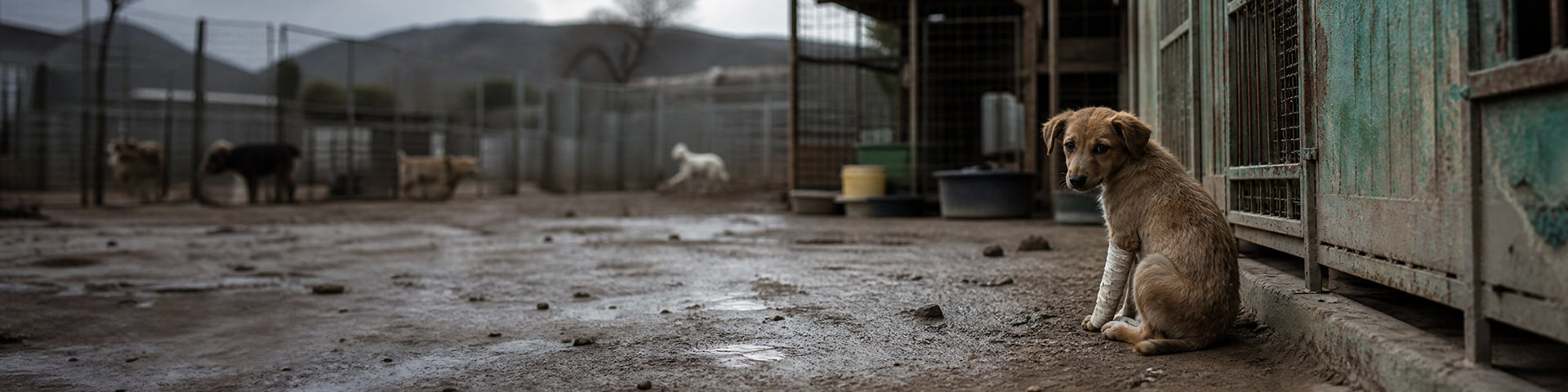

In our animal welfare work in South Africa, we kept returning to one central question: how can we help animals that have lost their mobility? They often come from the most difficult circumstances - physical disabilities, serious illnesses that make them especially sensitive to changes in their environment, or old age, where even the smallest extra effort can become a major challenge. After intensive conversations with numerous veterinarians and rehabilitation specialists, we came to understand that red light therapy can offer a highly suitable form of support for exactly this situation.
About us
Our story begins in Johannesburg, South Africa. During a volunteer mission to rescue stray animals, several core members of our team met there for the first time. During that time, we witnessed many difficult stories: animals physically marked by traffic accidents or human violence, yet still fighting for survival with remarkable strength. At that moment, we realised that they did not only need to be rescued. They needed healing.


After returning to our respective home countries, we decided to found a brand together with a mission focused on animal rehabilitation. Our motivation was simple: we wanted to help injured, elderly or ill animals regain their mobility - and with it, their dignity. The father of one of our team members, Mikko, an experienced animal rehabilitation therapist, introduced us to the positive effects of laser and red light therapy in animal rehabilitation. This insight marked the beginning of our journey to explore red light therapy more purposefully for animal recovery.
From that point on, supported by our different backgrounds in electrical engineering, veterinary medicine and business, we began to research, test and improve continuously. Our goal has always been to provide real support in animals' rehabilitation process through scientifically grounded, safe and effective light therapy. This is our starting point. It is the vision from which OsteoVitalis was born, and also the reason why we continue on this path with conviction today.

Not everything worked right away

Our first prototypes worked with 650 nm. However, the initial load and application tests quickly showed that 650 nm has clear limits under the requirements of broad-area, close-to-body use in animals. Especially with denser fur, stronger tissue or larger joint structures, penetration depth was lower than expected. At the same time, longer applications in enclosed, close-fitting surface structures caused local heat accumulation. Not at a critical level, but clearly outside what we considered optimal for long-term daily use. We therefore stopped development of the first generation completely and returned to the fundamentals.
In the following months, we analysed scientific studies, compared dosimetry data and held intensive discussions with veterinarians, photobiologists, physiotherapists and rehabilitation medicine specialists. In the end, every independent source led us to the same conclusion: 808 nm + 850 nm as the optimal combination for deeper tissue, joints and regenerative applications.
Technology must prove itself in everyday life

What works in the laboratory does not automatically mean an animal will accept it long term in daily life. That is why we sent our early prototypes to 240 pet families with different dog breeds, age groups, weights and movement profiles.
We observed not only therapeutic outcomes, but every detail of daily use:
- does the product sit securely?
- is pressure distributed evenly?
- is it easy to put on?
- will the animal accept it long term?
- is charging and storage simple in everyday life?
Every piece of feedback led directly to the next design adjustment. From cut and weight distribution to the fastening system and cordless charging design, every component was revised several times until the product worked as naturally in everyday life as it did in the laboratory.
Material selection for cleaning, hygiene and durability


From early on, we defined clear requirements for our materials: close skin contact, daily cleaning, long-term resilience and stable performance over many applications.
Our early prototypes were developed with neoprene-based functional textiles. Long-term testing quickly showed, however, that fur, moisture and regular cleaning place significantly higher demands on material and surface.

Was wir entwickeln, muss messbar sein

The effectiveness of light therapy does not come from higher power. It comes from the right dose.
That is why we worked with 50 fully documented comparison groups to observe different irradiation parameters under real-life conditions over the long term.
Among other factors, we considered:


